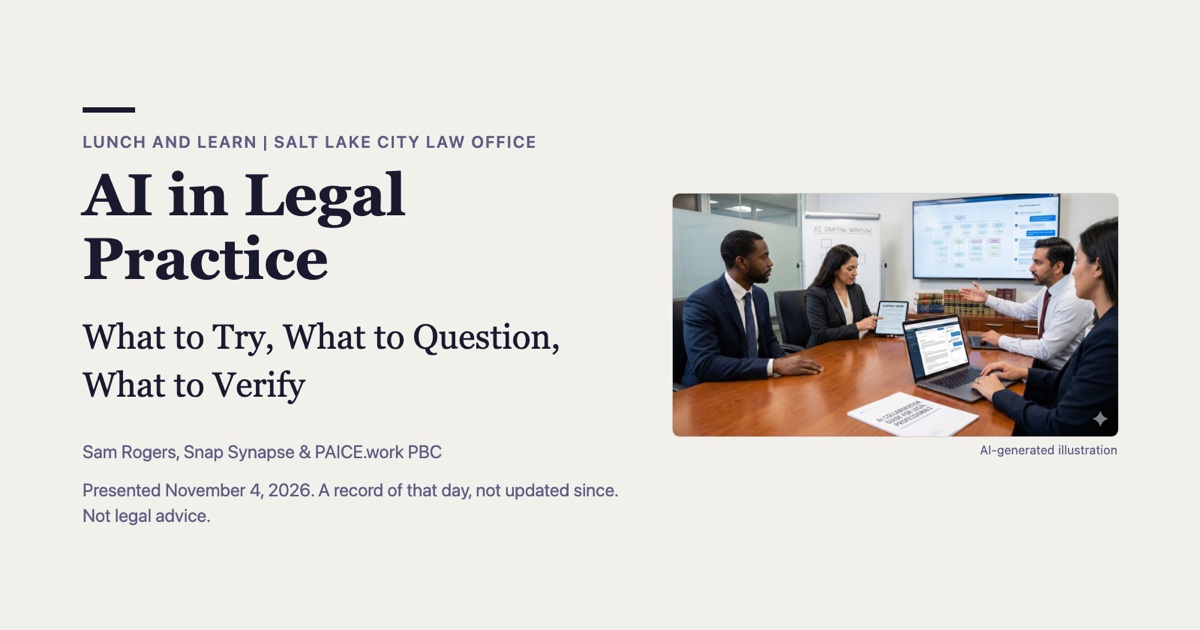
AI in Legal Practice
What to Try, What to Question, What to Verify
Four checks before an AI answer leaves your desk
- Open it.
- Does each cited source exist? Pull it up yourself, not from the AI's link text.
- Read it.
- Does the pinpoint actually say what the answer claims?
- Date it.
- Is it still good law, the current version, the right jurisdiction?
- Own it.
- Would you sign it? If not, it's a lead, not an answer.
One thing to try this week: stop asking the tool if it's sure. Ask for the quote and the pinpoint, then open it.
From the session
- The testing record: every demo answer, verbatim, with exhibit numbers and hashes
- The slides (arrow keys or space to move; works offline once loaded)
- The four checks, with a two-minute walkthrough and a prompt for any model
Sources
- Mata v. Avianca, S.D.N.Y. No. 22-cv-1461, ECF 54, Opinion and Order on Sanctions (June 22, 2023): the order
- Garner v. Kadince, 2025 UT App 80 (May 22, 2025): the opinion
- Beus Gilbert PLLC v. Brigham Young University, D. Utah No. 2:12-cv-00970-TS, ECF 385 (September 9, 2026): the docket
- Utah Rule of Professional Conduct 1.6, confidentiality: the rule
- Utah State Bar, AI Tools Utah Lawyers Can Use Today (January 15, 2026)
- Utah State Bar, Lexis+ AI and the Utah State Bar (January 12, 2026)
Questions later?
Sam Rogers, Snap Synapse & PAICE.work PBC: book 25 minutes.
Want this session for your office, with the demos re-run and every citation checked against your practice? AI in Legal Practice is quoted per firm.