Jun 15, 2026 | Issue 55
One analogy ⚖️ | One signal 🔭 | One subtraction ➖
Created by Sam Rogers, building PAICE.work | Freely available on Substack and LinkedIn | New issue every week
🔭 Signal: The Team Beat The Genius
In the drama of Anthropic’s ongoing Mythos / Fable story, OpenRouter’s clean experiment may not grab the headlines. But what it points to matters even more. A hundred deep-research tasks across ten domains, every model handed the identical toolkit. Then they compared the best single frontier model against a fusion setup: two or three models reasoning separately, with a judge model reconciling them into one answer.
The team beat the genius: Fable 5 plus GPT-5.5, fused, scored 69.0%. The best solo frontier model came in at 65.3%. Not a rounding error. A consistent, repeatable gap.
Then the finding that should change how you staff a problem. They fused a model with itself. Opus 4.8 reconciling Opus 4.8 still beat solo Opus. The lift wasn’t a second brand of genius in the room. It was the reconciling step itself: surfacing positions, weighing contradictions, synthesizing a defensible answer. That added more than any single model could.
And the cost twist: a panel of three cheap models landed within one percent of the frontier, at roughly half the price. The team of average beat the genius, and charged less.
Most organizations are doing the opposite. You hire the smartest single head, you buy the top-tier single model, you crown one source of truth. The research says that’s not where the gain lives. The gain lives in how disagreement gets reconciled. I’ve built teams this way for years without a name for it. Now there’s a benchmark.
A verdict you can defend was never the smartest person in the room. It’s what survived the argument.
➖ Subtraction: Stop Relaying
Here’s the trap inside “human in the loop.” Most of the time, that human is relaying: keying the number, chasing which figure is right, passing messages between systems. That’s the junior accountant re-entering transactions by hand. Real hours, pure drag.
The controller does something else. She sets the close rules and arbitrates the exceptions the system flags. Same headcount, one level up, opposite value. One is in the loop. One is above it.
Subtract the relaying. Stop confusing “human in the loop” with “human above the loop.” Then subtract its quieter cousin: premature consensus, the reflex to collapse a disagreement before anyone records it. Buried disagreement is the most expensive ambiguity you own.
Where the stakes are a benchmark, let a model be the judge. Where the stakes are your release or your numbers, that judge is you. Automate the reconciling. Never automate away the arbiter.
Measurable this week: pick one AI workflow with a person in it, and ask whether they’re relaying or arbitrating. If they’re relaying, that’s the seam to redesign.
⚖️ Analogy of the Week: The Jury, Not The Genius
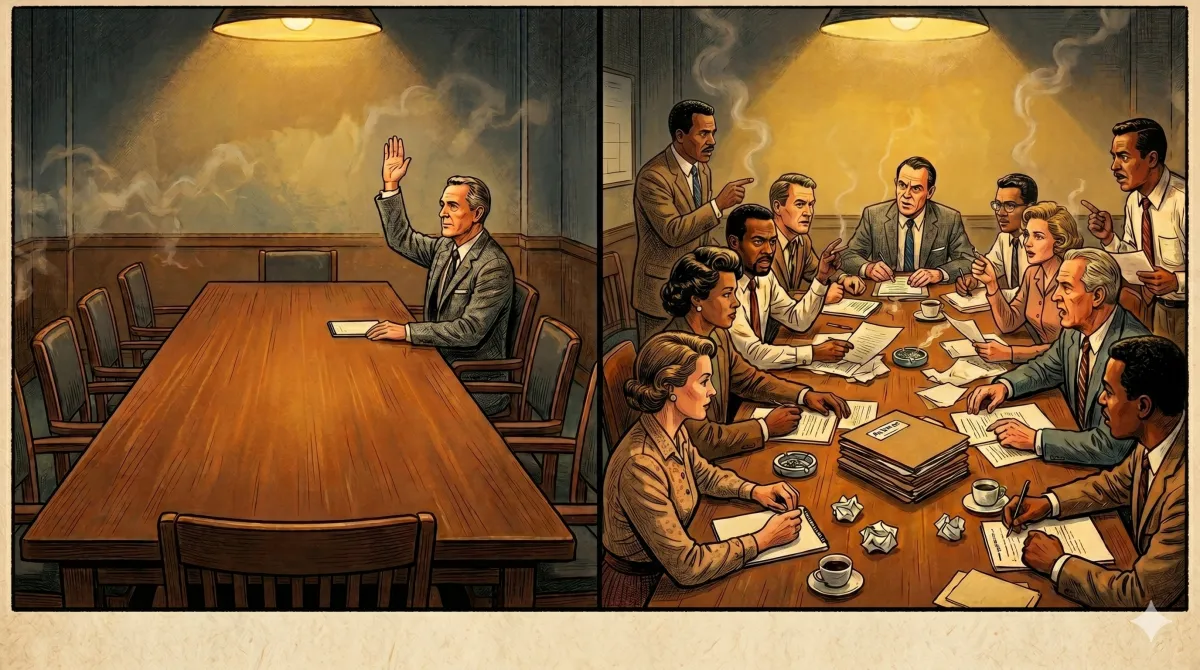
One juror, alone, certain in five minutes. Down the hall, twelve argue for three hours. The fast, confident, solitary juror feels like the smartest model: one shot, full conviction, no second-guessing. But the verdict that holds up on appeal is the one the room argued its way to, the one the foreman pulled together from twelve stubbornly certain positions.
Now notice who isn’t in the jury box. The judge. The judge sets the instructions, rules on what’s admissible, and presides. The judge stays above the loop, on purpose. For a parking ticket, you’d let a clerk or a model rule and move on. For a capital case, you keep a human on the bench, because consensus is not the same thing as correctness, and somebody has to own the call.
A hung jury is just disagreement with no process to resolve it. The fix was never fewer opinions. It was a way to turn twelve into a verdict.
The smartest juror doesn’t win the case. The process that reconciles twelve does.
🎵 Closing Notes
Teamwork makes the dream work, but only if the team is allowed to disagree out loud and someone with authority calls it. Fusion didn’t blend its models into mush. It surfaced the contradictions and ruled on them. That’s the whole trick, and it scales: automate the judge when the stakes are a benchmark, sit on the bench yourself when the stakes are real.
Fusion lets a judge model collapse the disagreement because the stakes are a score. When the stakes are your release, your legal posture, your numbers, you don’t want consensus. You want the objection on the record and the call routed to a human. That’s what Turnfile does: an open protocol where peer agents reason independently, a counter-recommendation is a first-class signal instead of an error, and the resolution gate stays yours. Orchestration tells you what ran. Turnfile tells you who objected before you acted, and keeps you above the loop.
One reply I’d genuinely read this week: where in your shop is a human relaying who should be arbitrating?
Until next Monday,
Sam Rogers Presiding, not deliberating
P.S. Turnfile keeps the human auditable. Next I’m pointing that same instinct at a harder gap: a real LLM-optimized language that humans can still read. Working name, Tokenese. Though I’ve been thinking this really loudly for years (and I’m sure I’m not the only one!) it seems the world forgot to invent it, so here I go again. More soon.