Jun 8, 2026 | Issue 54
One analogy 🏠 | One signal 🔭 | One subtraction ➖
Created by Sam Rogers, building PAICE.work | Freely available on Substack and LinkedIn | New issue every week
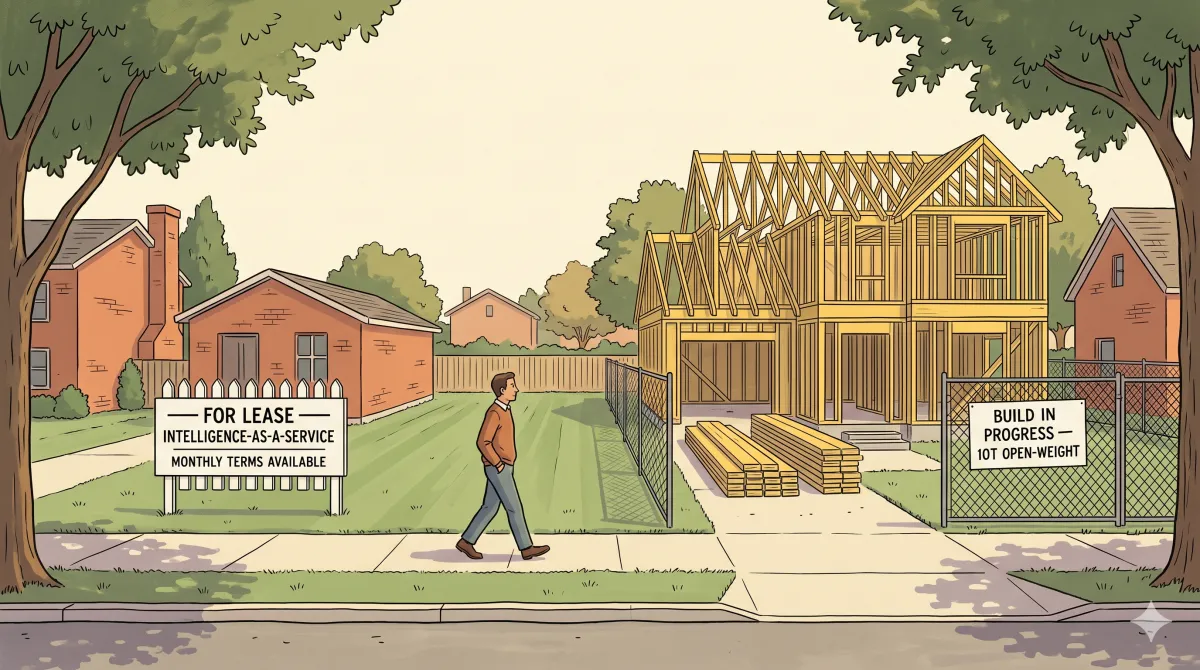
🏠 The Frame: Rent or Own?
Renting makes sense when you don’t know how long you’ll stay, when the unit serves a need you can’t predict, or when the market hasn’t given you a reason to buy. Two years ago, all three were true of frontier AI. Today, none of them are.
Remember back in 2020 when housing saw two opposing signals? Lumber spiking while mortgage rates collapsed to historic lows. People who closed paid more for the structure and locked in 3% money on a home they’d live in for twenty years. People who waited for lumber to come down got the upward lumber correction and the rate reset. By 2022 they were priced out of the house they could have built.
AI infrastructure is in that window right now. Hardware is the lumber. Rented intelligence is the rate. The 10T open-weight model arriving in two quarters is the house that’s already perfectly livable. The cost of waiting isn’t the wait. It’s the rent.
Here’s what’s in the window right now.
🔭 Signal: The Gap Just Closed
For the last few years, renting was the only rational move. The frontier was where models actually worked, and open-weight ran 12-18 months behind. So you paid rent. Most everyone did.
That gap is now closer to two quarters. By the end of this year we should see 10T-class open-weight models. These will be capable, runnable on owned enterprise hardware, yours to keep, tool-using, and (if you want) fully disconnected from the public internet.
Look at last week alone:
- Gemma 4 12B — Google’s sweet-spot generalist
- Qwen 3.6 — Alibaba’s remarkably stable MoE
- LFM 2.5 — Liquid’s real tool calling on edge hardware
- Nemotron 3 Ultra — NVIDIA’s long-running agent orchestrator
- Minimax M3 — Native multimodality with 1M context
Any one of those would have been frontier-class a year ago, maybe less. Five of them shipped in seven days, all open-weight, all ownable. That is the trail behind the frontier, and the trail is now a paved road.
Meanwhile hardware prices are climbing, not falling. Tariffs, demand, fab capacity, energy contracts. The instinct to “wait for it to get cheaper” is pointed the wrong direction for the first time in most of our careers. Every quarter you wait is a quarter the down payment grows.
One honest carve-out: some businesses rent the penthouse on purpose. They want the address, the deck slide, the prestige customers who need to see prestige in their vendors. If “we have SOTA” is your product, keep leasing it. But most of you are renting a duplex because that was the only thing on the market when you moved in. The market has moved.
The question isn’t whether the model is good enough (it is). It’s whether you still need a landlord.
➖ Subtraction: Stop Renewing the Lease by Default
Stop scoping internal builds to today’s API ceiling. Stop waiting for hardware to get cheaper. Stop paying SOTA rent on stable, recurring workloads. It’s all just a mortgage payment going to someone else’s equity.
And stop pretending rollout time is a reason to wait. It’s the opposite. Enterprise integrations regularly take two or three (sometimes four) quarters to actually land. Between security review, data plumbing, change management, the user training nobody budgets for. If you start today scoped to the API ceiling, you ship into yesterday’s economics. If you start today scoped to the open-weight model that will exist when you go live, same effort, same timeline, different math. Roll-out time is the case for owning, not against it.
Measurable this week. Pick one in-flight or in-production AI workload. Write down:
- A. projected monthly API spend at scale
- B. one-time cost to run the same workload on owned hardware against a near-future open-weight model
- C. realistic months-to-production for your org.
Multiply (A) by (C) plus 24, compare to (B). If (B) is smaller, you’re not renting strategically. You’re renting because nobody made you do the math.
🎵 Closing Notes
Rent-or-own isn’t an ideology. It’s a math question with a deadline.
The teams that win the next 18 months are the ones who closed before the next price move on hardware they (back)ordered, against the model that will exist when they ship, with the API line item shrinking instead of compounding.
If “we have SOTA” is your product, go rent the penthouse and don’t apologize for it. For everyone else: open the spreadsheet, run the line, and meet your future workload at the closing table.
The keys aren’t going to hand themselves to you.
Until next Monday,
Sam Rogers Closing Agent
P.S. One more thing before you sit at the closing table. If the math surfaces a deeper question like “do we even have a stated stance on this?” that’s a posture problem, not a procurement one. My new AI Posture whitepaper One Number You Can Defend works through the whole frame: capability, risk, vendor relations, build vs. buy.