Apr 27, 2026 | Issue 48
One people prompt 🧠
🔭 Signal: Not Even Wrong
While writing this on a Monday morning, I am also: cloning a Linux machine to an external drive, prepping to spin up three new local agents, rebuilding my entire newsletter pipeline, and responding to client messages. If you pinged me on Slack with “what are you working on?”, the honest answer is a list, not a noun.
!issue-048-desk.jpg
The singular-task question assumes singular-task attention. That assumption broke when humans started orchestrating parallel automated work instead of executing sequential manual work. The question doesn’t get answered wrong. It doesn’t get answered at all. It’s “not even wrong” as I put it ten years ago about a different broken frame first presented to me by Adam Savage of Mythbusters.
Here is the timely twist. Within the last 5 days Anthropic and OpenAI both shipped products that basically rewrite graphic design. The old definition of what making a deck or producing brand assets even is, moved. The dashboards did not. A polished asset lands and the dashboard says asset created. It cannot say an analyst orchestrated three generative tools to bypass the design queue entirely. The leverage is invisible at the reporting layer. The org sees output, not orchestration.
The job changed from doing tasks to keeping queues coherent. The question has to change with it to stay useful.
🧠 Strategic (Human) Prompt: What’s Running?
Pick one person on your team this week. Instead of “what are you doing?” ask “what’s running right now, and what’s blocked?”
Listen for the shape of the answer.
If it is a list of five or more parallel threads, you have an Orchestrator. Treat them like one.
If they freeze trying to pick a single item, your old question taught them to hide their parallel work. That is your data point.
If they truly are doing one thing, that is its own data point. They may not be using the leverage available, or they may be doing the kind of deeply focused work that deserves protection.
What you measure shifts what people will show you.
➖ Subtraction Opportunity: Single-Task Status
Cut the assumption that work is a noun.
Specifically, stop using status formats that demand a single current task. “What are you on right now?” Slack updates. Daily standups that require one work-in-progress item. Performance review templates with a current project field. Each of these forces orchestrators to either lie by simplification or look unfocused.
Replace with four buckets: what’s running, what’s blocked, what’s queued, what’s done this week. The format itself teaches the team that parallel work is the expected shape, not a tell of overwhelm.
And kill any dashboard tile that summarizes a person’s week as a single in progress item. That tile lies more than it informs.
If your team’s status format has not changed since 2022, it is measuring a kind of work that already left the building.
👨🍳 Analogy of the Week: Chef at the Dinner Rush
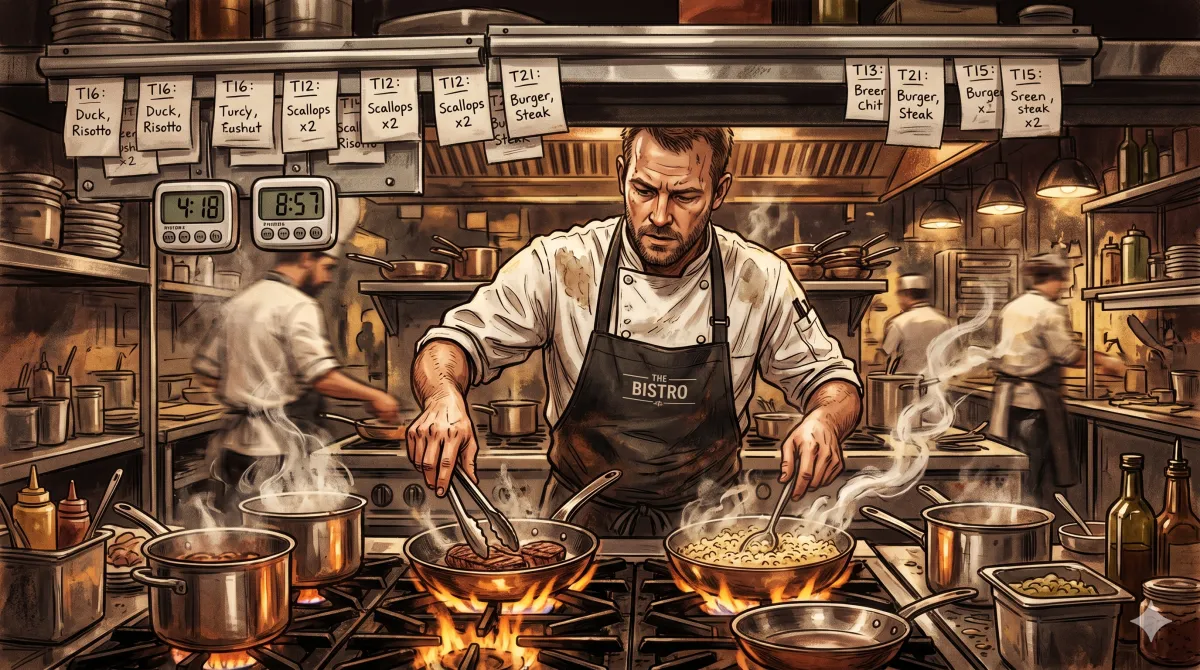
7pm Saturday. The kitchen is full noise. Six pans on the burners, two in the oven, prep cook running mise en place, fryer timer beeping, a dupe ticket landing every thirty seconds. The chef has not sat down in three hours.
!issue-048.png
The owner walks in and asks the chef “what are you cooking?”
The chef stares, while still in motion. There is no honest one-word answer. He is not cooking a thing. He is keeping the line coherent. The chicken is at four minutes, the risotto needs a stir, the sauce is about to break, table seven’s appetizer just got fired, and he is also tracking that the dishwasher is two stacks behind and a server is acting flustered and about to make a mistake but hasn’t yet.
The right question, the one a sous chef would actually ask, is “what’s on the pass and what’s behind?” That question gets a useful answer in less than three seconds. The owner’s question is not wrong exactly, but it’s not even in the neighborhood of something anyone could answer sensibly.
When the work is parallel, the only honest unit is the line, not the dish.
♬ Closing Notes
If you cannot see the parallel work directly, look for the seams. Things hitting the dashboard faster than the path implies. Batches arriving without a visible queue. Output that does not map to any job description in the org chart. Deliverables shipping with no intermediate artifacts: no draft, no Figma history, no version 2. The orchestrators show up in what is missing, not what is there.
This is not a vote against deep work. Deep work and what I’m calling “multi-multi-tasking” are not opposites. They are different surfaces. Deep work is the depth of attention on a single hard problem. Multi-multi-tasking is coherence across many machine-driven threads. You will likely do both this week.
The dashboard sees neither. Dashboards are slow to update what they’re measuring, and they’re always the last to know.
Build a way to see both yourself, or stop trusting what the dashboard tells you about your team’s leverage.
Try the new question this week. Watch what your team shows you that they were hiding before.
Until next week,
Sam Rogers Chief Cook & Orchestrator Snap Synapse from AI promise to AI practice
Running parallel AI tools? Keep their instructions coherent with one file to link them all: Agentlink A free and open-source approach from Snap Synapse.