Mar 16, 2026 | Issue 42
One people prompt 🧠
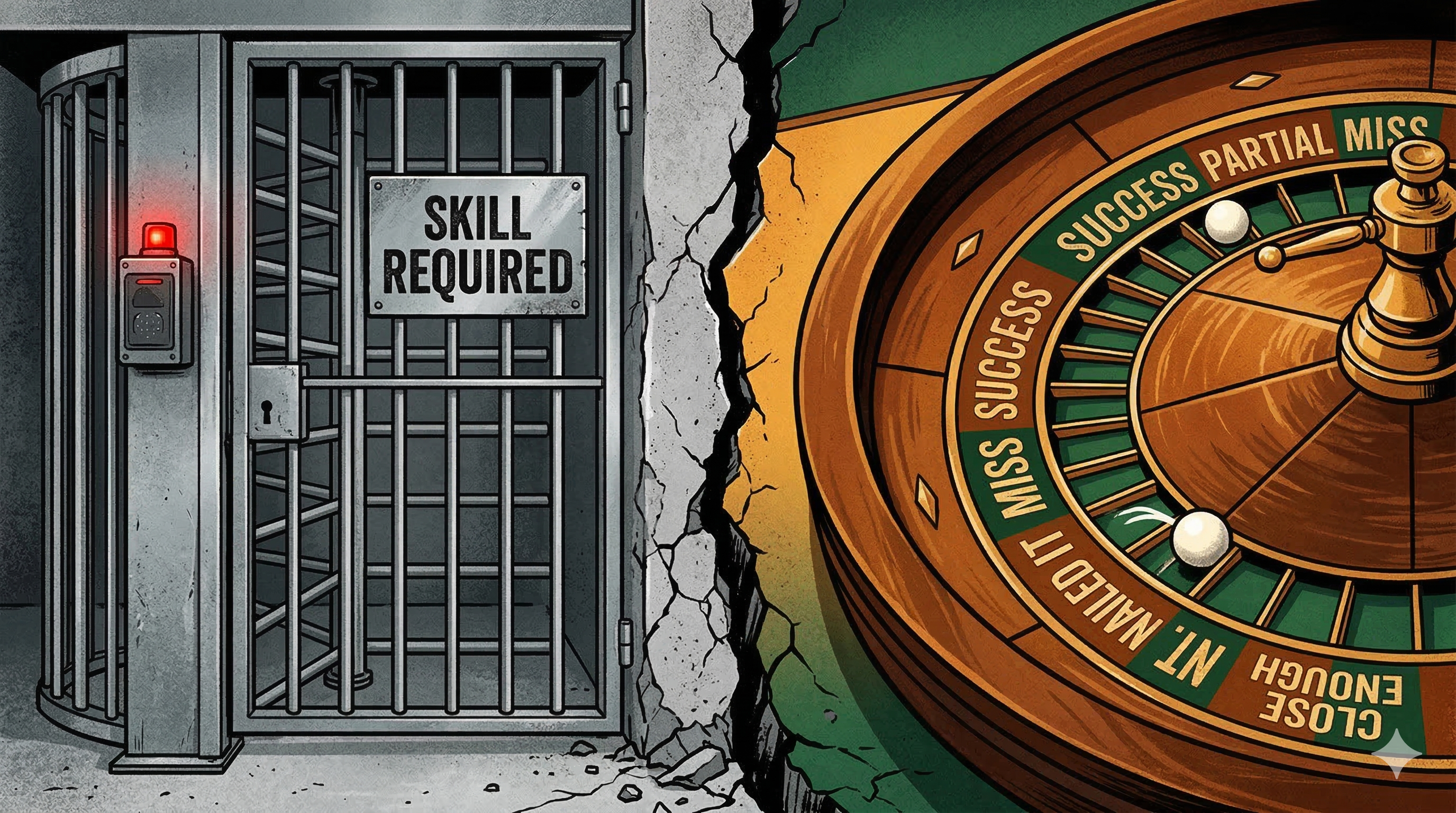
🔭 Signal: Skills Are Bets, Not Gates
Last week we flagged the vocabulary fork: “skills” now means two different things depending on which room you’re in. This week, a harder truth: the concept itself was already broken.
Here’s a common belief: if someone has the right skill, the outcome is handled. Certify the auditor, trust the audit. Train the analyst, trust the analysis. Certify the person, risk goes down. Skill in, result out.
But think about it for a moment. When was it ever that neat and tidy?
Simple example: A person with low vision visits your website. They have no accessibility credentials, they’ve never even heard of WCAG 2.1 AA. They just try to use the site, and within seconds they know whether it works for them or not. No training required. No certification. The outcome (detecting whether the site is accessible) happened without any formal skill at all. It’s built into the nature of their perception.
Meanwhile, a certified accessibility auditor can run a full compliance check on that same site and still miss the thing that makes it unusable for that specific person. The skill increased the odds. It didn’t own the outcome.
This was always true, for every skill, in every field. But it didn’t matter as much when skills were only a human thing. We could live with the polite fiction that certification meant competence and competence meant results. Pre-fork.
Now that agents have installable skills too, post-fork, that fiction gets expensive fast. An organization that believes “install the skill, trust the output” will over-trust agent results the same way it over-trusted credentialed humans: by confusing a bet with a guarantee.
Skills are probabilistic. They always were. They improve your odds in a given context. They are not gates we must pass through, and have never been promises that any outcome will land.
🧠 Strategic (People) Prompt: What’s Guaranteed?
Instead of asking: Do our people have the right skills for this? Ask: What outcome is our team treating as guaranteed because someone has the skill on paper?
Follow it with:
- Where has a certified person or a validated tool still produced a wrong result recently?
- Where has someone without the expected credential produced the right result anyway?
The answers will show you where the organization is confusing insurance with prevention.
➖ Subtraction Opportunity: The Word “Ensure”
Find every sentence in your current strategy docs, training plans, and vendor contracts that connects a skill to a result using the word “ensure.”
“This certification ensures quality.” “This training ensures compliance.” “This agent skill ensures accurate output.”
Replace “ensure” with “increase the likelihood of.”
Read the sentence again. If it still sounds like a reasonable investment, by all means keep it. But note that if it suddenly sounds like a stretch, you’ve found a bet your organization is treating as a guarantee. That’s a gap where the expensive surprises live.
🛡️ Analogy of the Week: Fire Insurance
You buy fire insurance on your house. You pay the premium every year.
The insurance doesn’t prevent fires. It doesn’t fireproof your wiring. It doesn’t stop a kid from leaving a candle burning inside. What it does is improve your odds of recovering if a fire happens, under specific conditions spelled out in a policy most people never fully read.
Now imagine someone who buys the insurance, then removes the smoke detectors because “we’re covered.” That’s what happens when organizations treat skills as guarantees instead of bets. The coverage is real, but it only pays off under the right conditions, and it never replaces the need for ongoing vigilance.
Skills work the same way, whether they belong to a person or an agent. They’re bets encoded in different substrates (practice and judgment for humans, weights and code for agents) about how to move from context to action to result. Good bets. Often very good bets. But still bets.
Having the policy doesn’t mean you can skip the smoke detector.
♬ Closing Notes
This is the second in our skills series. Next week: what happens when you can package expertise so that someone who doesn’t have it can still place their all-important bet?
I built an accessibility audit skill recently that does exactly that. More on what it revealed next Monday.
Until next week,
Sam Rogers Chief Actuary of Capability Snap Synapse – from AI promise to AI practice
📅 Book a meeting If skills are bets, you need a way to measure whether they’re paying off. PAICE.work scores how humans and AI actually collaborate.