Mar 9, 2026 | Issue 41
One people prompt 🧠
🔭 Signal: Skills Ain’t What They Used to Be
For as long as most of us have been working, “skills” meant one thing: what people can do. The entire vocabulary around skills (building them, assessing them, certifying them, mapping them to roles) assumes a human on the other end.
That assumption broke.
It started in October when the skills.md file became a thing in Anthropic’s Claude. Late last year OpenClaw, the open-source personal AI agent, exploded and turned skills into installable packages that any agent could load and run…on their own. The community built thousands of them practically overnight. Then it wasn’t just Claude anymore, OpenAI Codex, Gemini CLI, GitHub Copilot, Cursor, Perplexity and more all support skills. This past week, “Skills 2.0” landed with structured evaluations, benchmarking, and optimization tooling. As of today, ClawHub alone hosts over 13,000 community-built agent skills (a few of them are mine).
So… according to the internet and every IT department, a “skill” is now a folder you can install.
Meanwhile, L&D teams are still mapping competency frameworks. HR is still building skills taxonomies. Talent teams are still running skill-gap analyses. All of them still mean people when they say “skills.”
Neither room seems to know the other one’s definition changed.
This matters beyond vocabulary. When a leader hears “we can install that skill,” some will hear efficiency. Others will hear headcount reduction. And the people whose jobs overlap with a newly installable skill? They’ll hear the floor creak beneath them, whether or not anyone intended it.
History is full of moments where a word changed meaning and the people who didn’t notice paid the price. This is one of those moments. Over the next four issues, we’ll be taking this head on.
🧠 Strategic (People) Prompt: Which “Skills” Are You Talking About?
Next time the word “skills” comes up in a meeting, pause and ask:
Are we talking about what our people can do, or what our systems can do?
If the answer isn’t immediately obvious to everyone in the room, congratulations! You’ve found the gap that matters most this quarter.
➖ Subtraction Opportunity: One Word, One Meaning
Stop using the word “skills” without a qualifier. Starting today.
Every strategy doc, every roadmap, every meeting agenda: if it says “skills” without specifying human skills or agent skills, flag it, axe it. Not because precision is a hobby, but because ambiguity here has real consequences. A workforce planning conversation where half the room means people and the other half means software is how you end up cutting the wrong things and installing the wrong things in the same quarter.
Add the magic qualifier now, before the collision happens somewhere it can’t be walked back.
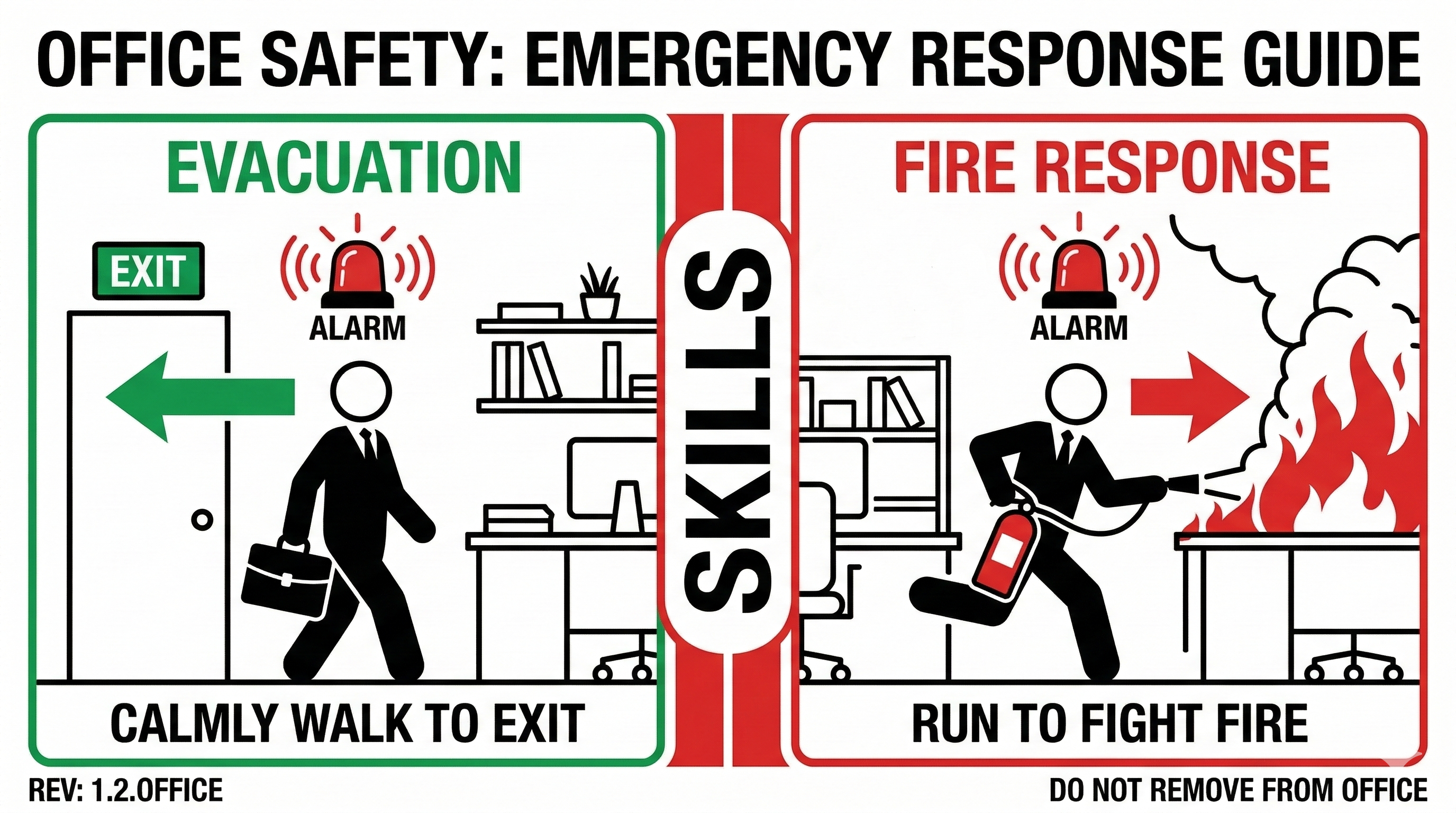
🧯Analogy of the Week: Fire!
Someone yells “FIRE!” in the office building.
Half the people sprint for the exits. The other half grab extinguishers and head toward the smoke.
Same word. Opposite responses. One group heard threat. The other heard task.
Now they meet in the hallway, moving at full speed in opposite directions. That’s where people get hurt. Not because anyone was wrong, but because nobody stopped to ask which kind of fire they were responding to and what their role in it was.
That’s the “skills” conversation in most organizations right now. HR/L&D are complying with policy and heading for the exits of an old framework. Engineering is running toward a new one. Both are moving fast, both are acting on real information, and neither checked whether the other group heard the same word the same way.
BAM! The word didn’t cause the collision. The missing context did.
♬ Closing Notes
This is the first in a series on how the meaning of “skills” is changing in real time. Next week: why skills were never guarantees in the first place, and why that matters even more now that agents have them too.
The vocabulary is forking. The budgets haven’t caught up. And the people who notice first will be the ones who build something coherent on both sides of it, instead of watching one side get flattened.
Until next week,
Sam Rogers Vocabulary Collision Spotter Snap Synapse – from AI promise to AI practice
📅 Book a meeting Measure your team’s actual AI collaboration behaviors (not just their vocabulary) at PAICE.work – free during research preview.