Dec 29, 2025 | Issue 31
The only skill that matters is not prompting. It’s collaboration.
But not just collaboration between people. People+AI collaboration.
Over the next year, individual skills will stop being the unit of value at work. Not because skills disappear. Because AI collapses them into a single meta-skill.
As execution gets cheaper and faster, the differentiator quietly shifts. What matters is no longer what any one person can do in isolation, or even what teams can do without machines in the loop. What matters is how well humans and AI can coordinate at speed.
Most organizations are discovering something uncomfortable: They were never optimized for collaboration. They were optimized for competent, compliant individuals inside slow, forgiving systems.
AI didn’t create this problem. It just exposed it.
Quick diagnostic for you: If AI made your core workflows 10× faster tomorrow, what would actually snap first?
- handoffs
- trust
- escalation
- judgment timing
That’s where the real work is now. And that’s what I unpack this in this week’s final Signals & Subtractions of 2025. Read it if you’re more interested in calm clarity than hype for 2026.
If this feels extreme, that’s not a warning. It’s a signal.
The only skill that matters is not prompting. It’s collaboration.
But not collaboration between just us people. People+AI collaboration.
Over the next year, individual skills will stop being a unit of value at work. Because the nature of work itself is shifting most everywhere. Our skills don’t disappear, AI simply collapses them into a single meta-skill.
As execution gets cheaper and faster, the differentiator quietly shifts. What matters is no longer what any one person can do in isolation, or even what teams can do without machines in the loop. What matters is how well humans and AI can coordinate at speed.
Most organizations are discovering something uncomfortable: They were never optimized for collaboration. Like, at all. They were optimized for competent and compliant individuals inside slow, mostly forgiving systems.
AI didn’t create this problem any more than it created work slop. It merely exposes such things.
A quick diagnostic for you: If AI made your core workflows 10× faster tomorrow, what would actually snap first?
- handoffs
- trust
- escalation
- judgment timing
That’s where the real work is now. And that’s what I unpack this in this week’s final Signals & Subtractions for 2025. Read it if you’re more interested in calm clarity than hype for 2026.
If this feels extreme, that’s not a warning. It’s a signal.
Issue-031
🔭 Signal: AI Collaboration is the Master Skill
Over the next year, individual skills will stop being the unit of value in the workplace.
Not because non-AI skills disappear. Because AI collapses them.
As execution becomes cheaper, faster, and more abundant, the differentiator quietly shifts. What matters is no longer what any one person can do in isolation, or even what teams can do without machines in the loop. What matters is how well humans and machines can coordinate effectively at speed.
Most organizations are discovering, often uncomfortably, that they were never optimized for collaboration at all, let alone at an inhuman pace. They were optimized for competent individuals operating inside slow, forgiving systems.
That era is going the way of 2025 desk calendars.
🧠 Strategic (Human) Prompt: Where is your Collaborative Friction?
When things speed up, where does collaboration break in your organization?
AI did not create this problem, but it certainly exposes it. Don’t fixate on skill or effort. Look instead at:
- Where handoffs fail.
- Where trust erodes.
- Where escalation freezes.
- Where judgment arrives too late.
If AI made your core workflows ten times faster tomorrow, what actually snaps first? Fixate on this.
➖ Strategic Subtraction: Individual Skills
Stop treating skills as independent assets to be built, allocated, or managed.
Subtract these to refocus on what matters more:
- role-based skill matrices that assume static work
- “AI literacy” as a standalone initiative
- individual performance optimizations separate from system outcomes
- adoption metrics that mistake visibility for value
These models made sense when execution was scarce and slow. For 2025, no harm, no foul. In 2026 the game changes and these actions produce penalties.
The thing to build is not better users. It’s better collaboration surfaces.
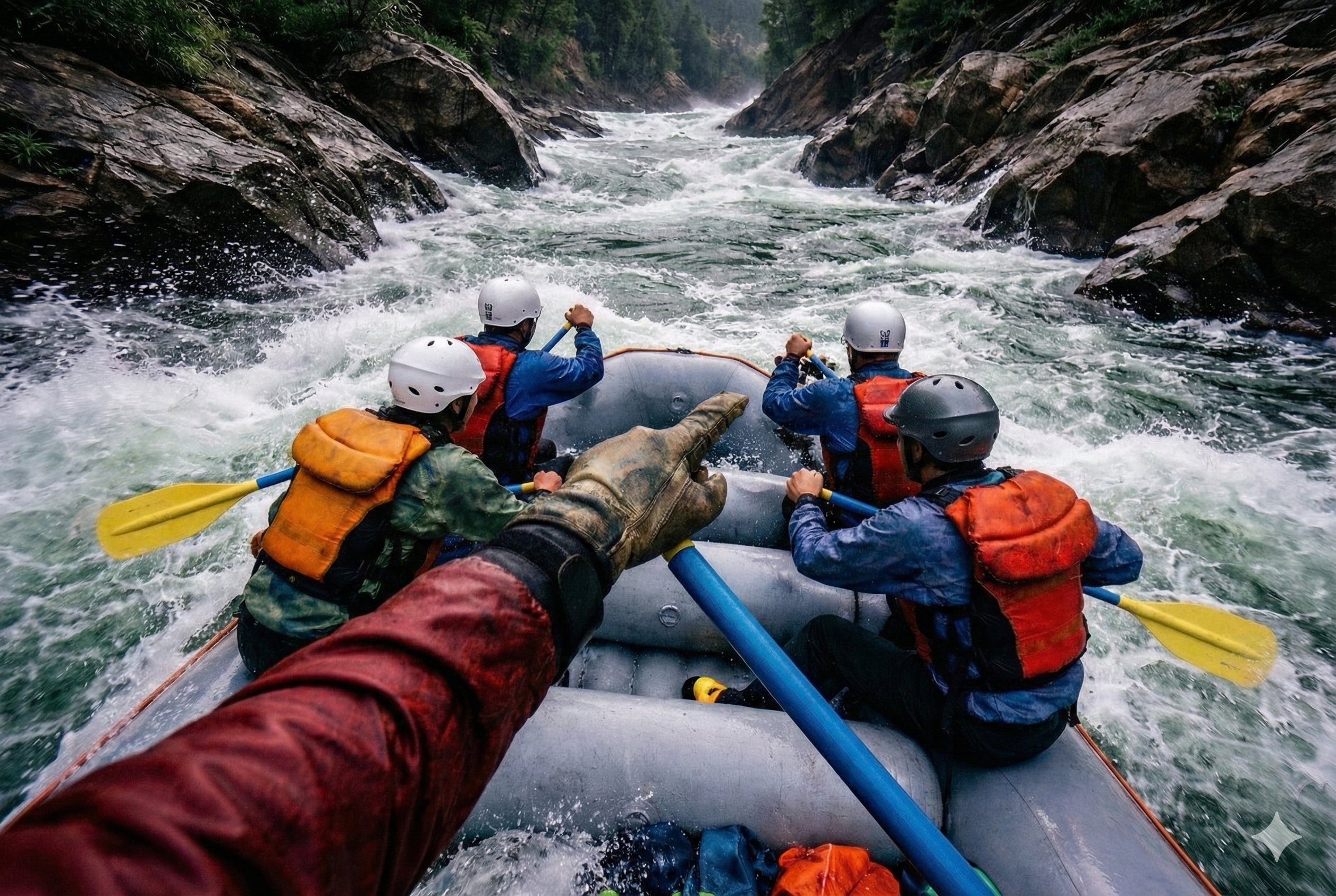
🌊 Analogy of the Week: Riding Rapids
At first glance, whitewater rafting has similarities with rowing. It’s a team of people working together in a small boat with no sails or engines.
But get in that boat and whitewater rafting is suddenly not at all like rowing.
Rowing rewards individual strength, timing, and discipline. A winning rowing team is impressive in calm, predictable conditions.
Whitewater rafting exposes something else entirely: shared awareness, rapid coordination, and recovery when the plan stops working.
A championship rowing team may not survive a whitewater run any better than you, me, and a random handful of strangers. They know how to work together, but they are ill-equipped to do it at that speed or in those conditions.
AI has turned our workplace rivers into rapids. Strength still matters, but only insofar as the crew can read the water together and learn to work with it.
This also requires a different form of leadership than the rowing captain. The guide on a whitewater raft isn’t coordinating strokes. They’re reading the water, using their domain expertise to make predictions and see around corners. They’re also communicating the plan before the rapid (rather than in it), coordinating team recovery, and aligning for safety above heroics.
🎵 Closing Notes
AI collaboration is not a future skill to acquire. It’s a present condition to recognize.
Most organizations are already being evaluated on their ability to collaborate with AI. They just aren’t measuring it well enough to understand it. Yet.
If this feels extreme, that’s not a warning. It’s a signal.
Until next time,
Sam Rogers AI Whitewater Guide Snap Synapse – from AI promise to AI practice
Ready to benchmark your team’s AI collaboration effectiveness before they tip the raft? The PAICE.work Founding Partner Program might be for you.